
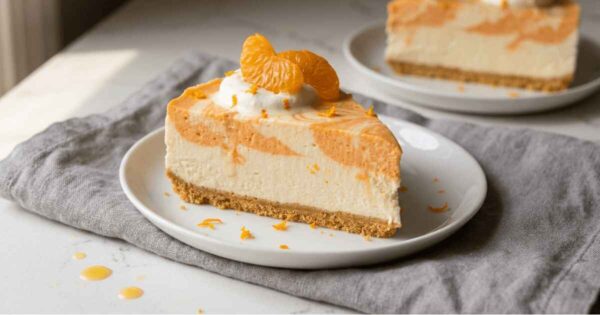
This no-bake orange creamsicle cheesecake skips the oven entirely. A graham cracker crust holds a vanilla cheesecake filling swirled with bright orange, and the whole thing sets in the fridge while you do something else with your afternoon.
If you’ve made our orange creamsicle poke cake, this is a different animal completely. No cake mix, no oven, no holes to poke. Just cream cheese, whipped cream, a packet of orange gelatin, and patience.
The tricky part with any no-bake cheesecake isn’t the recipe. It’s the setting. Get the cream cheese temperature wrong or rush the chill time and you end up with something closer to orange pudding than cheesecake. That part gets covered in detail below.
Key Takeaways
- Use cold block cream cheese, not the spreadable tub kind, for a filling that actually sets
- Whip the cream and beat the cream cheese separately, then fold them together by hand
- Minimum chill time is 6 hours. Overnight is better and removes most of the guesswork
- This dessert is ready to slice and serve straight from the fridge, no thawing required
Table of Contents
What Makes This Cheesecake “No-Bake”?
No eggs. That’s the short answer. A regular cheesecake sets because the eggs cook and firm up in the oven. This one skips eggs entirely and relies on cold cream cheese, whipped cream, and a small amount of gelatin to hold its shape once chilled.
The texture ends up lighter than a baked New York cheesecake. Less dense, more like a thick mousse that holds a clean slice once it’s fully set. The orange layer adds a second texture on top: slightly firmer, more gelatin-forward, with that bright citrus snap.
Why does temperature matter so much here? Cream cheese that’s too warm won’t hold air properly when whipped, and the filling stays loose no matter how long it sits in the fridge. Cream cheese that’s too cold creates lumps that never smooth out. The sweet spot is firm but pliable, not soft and not fridge-hard.
This is also why a stand mixer can work against you. The mixing process generates friction heat, and if your cream cheese started out too soft, beating it just makes the problem worse. Separating the two components, whipped cream in one bowl, cream cheese mixture in another, then folding them together by hand gives you full control over the final texture.
Why Skip the Oven for This Recipe?
Summer is the obvious reason. Nobody wants to run an oven for an hour when it’s 95 degrees outside. But there’s a flavor reason too: the no-bake method keeps the orange flavor brighter and more distinct than a baked version, where heat tends to mute citrus notes.
Ingredients
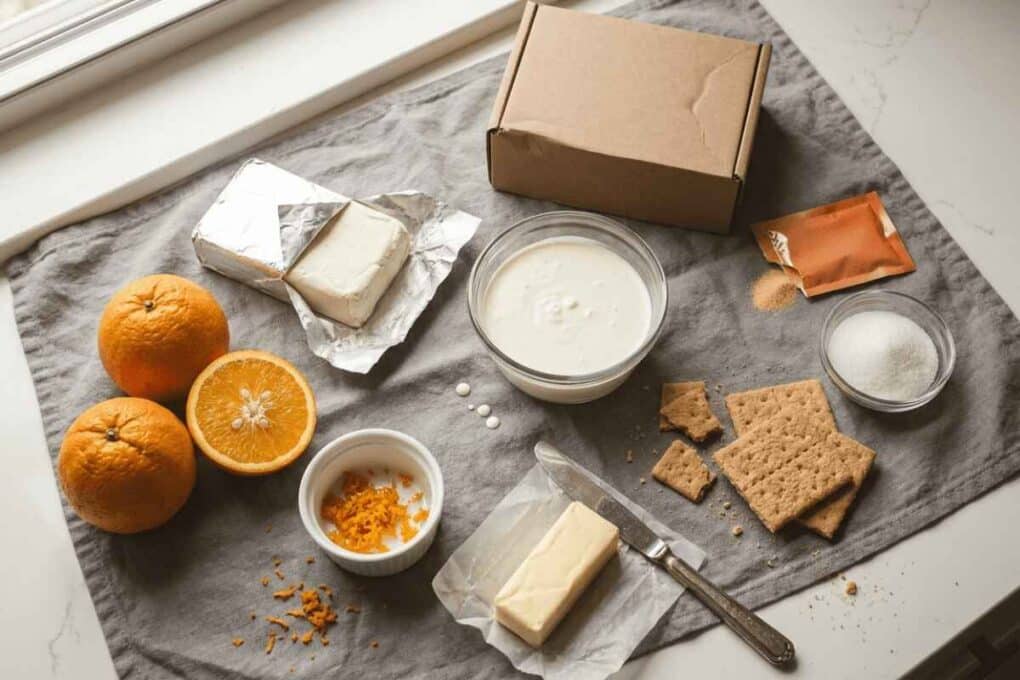
For the crust:
- 1 1/2 cups graham cracker crumbs (about 10 to 12 full sheets, crushed)
- 1/4 cup granulated sugar
- 6 tablespoons unsalted butter, melted
For the cheesecake layer:
- 16 oz block cream cheese, cold but not fridge-hard
- 1/2 cup granulated sugar
- 1 teaspoon vanilla bean paste (or vanilla powder)
- 1 cup heavy whipping cream, cold
For the orange layer:
- 1 box orange gelatin dessert mix (3 oz)
- 1 cup boiling water
- 1 tablespoon fresh orange zest
- 1/2 cup of the prepared cheesecake mixture (set aside from above)
For garnish:
- Fresh whipped cream
- Orange zest
- Orange segments or canned mandarin slices, drained
A Note on Cream Cheese
Use the block kind that comes wrapped in foil, not the soft spreadable tub version sold for bagels. The tub version has more moisture and air whipped in already, and it will not set the same way. This is the single most common reason a no-bake cheesecake fails to firm up.
Quick swap table:
| Original | Swap | Notes |
|---|---|---|
| Graham cracker crust | Vanilla wafer crust | Slightly sweeter, more vanilla-forward |
| Granulated sugar in filling | Powdered sugar | Less gritty texture, dissolves more smoothly |
| Fresh orange zest | Orange extract (1/4 tsp) | More concentrated flavor, less texture |
| Heavy whipping cream | Whipped topping | Faster, slightly less stable structure |
How to Make It, Step by Step
This recipe has two real phases: an active 20 to 25 minutes of mixing and assembling, then a long passive wait while the fridge does the rest.
Active time: About 25 minutes Total time with chilling: 6 hours minimum, overnight is better
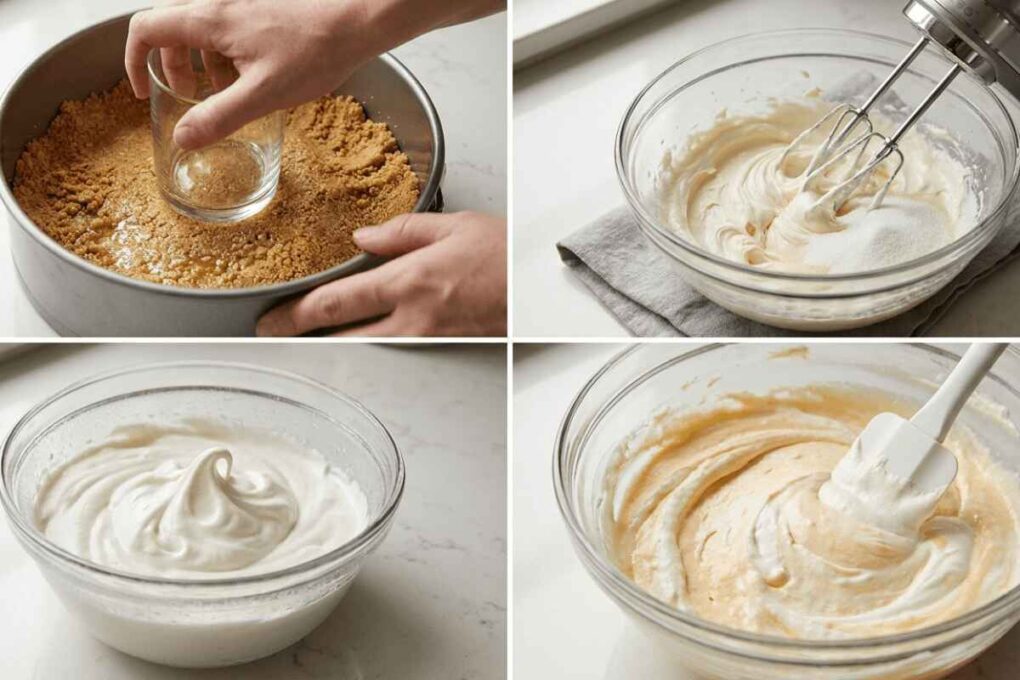
Step 1: Make the crust Combine graham cracker crumbs, sugar, and melted butter in a bowl until the mixture looks like wet sand. Press firmly into the bottom of a 9-inch springform pan, going slightly up the sides if you’d like a defined edge. Place in the freezer for 30 minutes while you prepare the filling.
Step 2: Beat the cream cheese In a large bowl, beat the cold block cream cheese with sugar and vanilla until completely smooth, scraping down the sides as needed. No lumps should remain. This usually takes 2 to 3 minutes on medium speed.
Step 3: Whip the cream separately In a separate bowl, whip the cold heavy cream to stiff peaks. This takes 3 to 5 minutes with a hand mixer. The cream is ready when it holds its shape and doesn’t slide when you tilt the bowl.
Step 4: Fold them together Gently fold the whipped cream into the cream cheese mixture using a spatula, not the mixer. Stop as soon as the mixture is uniform. Overmixing at this stage knocks the air back out and you lose the light texture you just built.
Step 5: Set aside the orange portion Remove about 1/2 cup of the finished cheesecake mixture and set it aside in a small bowl. You’ll combine this with the orange gelatin in the next step.
Step 6: Pour the base layer Spread most of the remaining cheesecake mixture over the chilled crust, leaving a thin layer of plain mixture for the swirl. Smooth the top with an offset spatula.
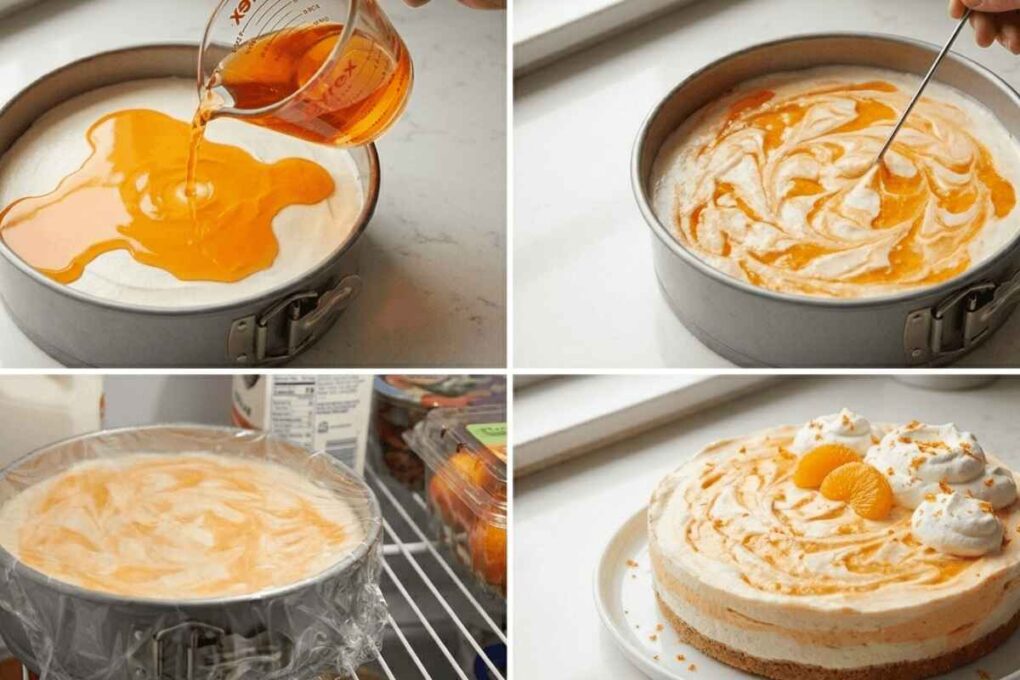
Step 7: Make the orange layer Dissolve the orange gelatin in 1 cup boiling water, stirring for 2 minutes until fully dissolved. Whisk in the fresh orange zest. Let the mixture cool to room temperature, about 20 to 30 minutes. Once cooled, whisk in the reserved 1/2 cup of cheesecake mixture until smooth.
Step 8: Swirl and chill Pour the orange mixture over the cheesecake layer. Use a knife or skewer to swirl gently, creating a marbled pattern without fully mixing the two layers. Cover and refrigerate for at least 6 hours, ideally overnight.
Step 9: Garnish and serve Run a thin knife around the edge of the springform pan before releasing the sides. Garnish with fresh whipped cream, orange zest, and orange segments right before serving. Slice with a clean knife between cuts.
Why the Two-Bowl Method Matters
Whipping the cream and beating the cream cheese in separate bowls, then combining by hand, gives you full control over texture. Combine them too early in one bowl with a mixer and you risk overbeating the cream cheese while trying to get the cream to stiff peaks, which turns the whole mixture soupy with no way to recover it.
5 Things That Go Wrong (And Why)
Most no-bake cheesecake failures trace back to one of these five problems.
Mistake 1: Using cold or warm cream cheese instead of cool and firm Cream cheese straight from the fridge creates lumps that never smooth out. Cream cheese left out too long on a warm day softens past the point of holding shape. The right temperature is cool to the touch but pliable when pressed.
Mistake 2: Using spreadable tub cream cheese The tub version has extra moisture and air already whipped in. It looks like cream cheese but behaves completely differently once chilled. Stick to the foil-wrapped block.
Mistake 3: Adding hot gelatin directly to the cheesecake mixture Pouring warm gelatin straight into cold cheesecake mixture causes it to seize and clump. Always let the dissolved gelatin cool to room temperature, about 20 to 30 minutes, before combining.
Mistake 4: Rushing the chill time Six hours is the floor, not a target. The filling needs that time to firm up fully. Cutting into it after two or three hours, no matter how tempting, gives you a soft slice that won’t hold its shape on the plate.
Mistake 5: Overmixing the whipped cream into the cream cheese Stirring too long after the two are combined knocks the air back out. Fold gently with a spatula and stop the moment the mixture looks uniform.
Make-Ahead, Storage, and Freezing
This cheesecake is built for making ahead. It needs the long chill time regardless, so plan to make it the day before you need it.
Fridge storage: Covered tightly, up to 1 week. The texture holds up well across multiple days.
Freezer: Wrap the whole cheesecake or individual slices tightly in plastic wrap, then a layer of foil. Freezes well for up to 2 months. Thaw fully in the refrigerator overnight before serving, not at room temperature.
Serving tip: This cheesecake is best served cold, straight from the fridge. The texture firms up slightly more at refrigerator temperature than it does sitting out, and that firmness is what gives you clean slices.
For an orange dessert that goes a completely different direction, our orange creamsicle poke cake uses cake batter and orange gelatin poured into holes rather than a no-bake cheesecake structure. Different technique, same flavor family.
The setting science behind gelatin desserts comes down to protein structure. Gelatin is a protein derived from collagen that forms a gel network as it cools, which is exactly the mechanism holding your orange swirl layer together.
Frequently Asked Questions
1. Can I use a regular pie dish instead of a springform pan?
Yes, but releasing the cheesecake cleanly is harder without removable sides. Line a pie dish or square pan with parchment paper, leaving overhang to lift it out later.
2. Can I make this without gelatin?
The orange layer needs gelatin to set into a distinct swirl. Without it, the orange mixture stays loose and blends into the cheesecake layer instead of creating a marbled effect.
3. What’s the difference between block cream cheese and the tub kind?
Block cream cheese is firmer with less moisture and air whipped in, which is why it sets properly in no-bake recipes. Tub cream cheese is softer and will not firm up the same way, even after a full chill.
4. Can I add too much orange flavor and ruin the texture?
Yes. Extra juice, extract, or puree beyond what the recipe calls for loosens the filling and makes it harder to set. A teaspoon or two of extra zest is fine; extra liquid is not.
5. Does humidity affect how this cheesecake sets?
It can. Excess moisture in the air slows the setting process slightly. In a humid kitchen, give the cheesecake extra chill time, an hour or two beyond the 6-hour minimum, before slicing.
An Honest Take
No-bake cheesecakes have a reputation for being unreliable, and that reputation comes from real experience. A lot of first attempts come out too soft, or the orange layer bleeds into the cheesecake instead of staying distinct. Both problems trace back to temperature, not technique difficulty.
Once you get the cream cheese temperature right and respect the chill time, this recipe is genuinely simple. No oven, no water bath, no cracked top to worry about. The orange swirl looks more impressive than the effort it takes to make it.
If you’ve made the poke cake version already, this one feels almost lazy by comparison. Less active time, fewer steps, same flavor payoff.
More from the orange dessert collection: the orange creamsicle poke cake for a cake-based version, or the orange creamsicle cake for a classic frosted layer cake.
If you love nostalgic orange‑vanilla flavors, you might enjoy reading about the history of Creamsicle desserts and National Creamsicle Day.
Print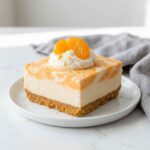
No-Bake Orange Creamsicle Cheesecake
- Total Time: 6 hours 25 minutes
- Yield: 12 servings
- Diet: Vegetarian
Description
This No-Bake Orange Creamsicle Cheesecake combines a buttery graham cracker crust, a light vanilla cheesecake filling, and a refreshing orange layer for the perfect chilled dessert. Creamy, citrusy, and effortless to make, it’s ideal for warm-weather gatherings and holiday celebrations.
Ingredients
1 1/2 cups graham cracker crumbs
1/4 cup granulated sugar
6 tablespoons unsalted butter, melted
16 ounces block cream cheese, softened but still cool
1/2 cup granulated sugar
1 teaspoon vanilla bean paste
1 cup cold heavy whipping cream
1 box (3 oz) orange gelatin dessert mix
1 cup boiling water
1 tablespoon freshly grated orange zest
1/2 cup reserved cheesecake filling
Fresh whipped cream for garnish
Fresh orange zest (optional)
Mandarin or fresh orange segments, drained (optional)
Instructions
- Mix the graham cracker crumbs, sugar, and melted butter until evenly coated. Firmly press the mixture into the bottom of a 9-inch springform pan and freeze for about 30 minutes.
- Beat the cream cheese with the sugar and vanilla until smooth and creamy with no lumps remaining.
- In a separate bowl, whip the heavy cream until stiff peaks form, then gently fold it into the cream cheese mixture until fully combined.
- Reserve 1/2 cup of the cheesecake filling, then spread the remaining filling evenly over the chilled crust.
- Whisk the orange gelatin into the boiling water until completely dissolved. Stir in the orange zest and allow the mixture to cool for 20–30 minutes.
- Blend the reserved cheesecake filling into the cooled gelatin until smooth, then carefully pour it over the cheesecake layer. Lightly swirl the layers with a knife if desired.
- Cover and refrigerate for at least 6 hours, or overnight for the best texture. Remove the springform ring, garnish with whipped cream, orange zest, and orange segments, then slice and serve chilled.
Notes
Use block-style cream cheese for the firmest texture.
Allow the gelatin mixture to cool before combining it with the cheesecake filling to prevent curdling.
Overnight chilling produces cleaner slices and a better set.
Store covered in the refrigerator for up to 1 week or freeze for up to 2 months.
- Prep Time: 25 minutes
- Cook Time: 0 minutes
- Category: Dessert
- Method: No-Bake
- Cuisine: American
Nutrition
- Serving Size: 1 slice
- Calories: 365
- Sugar: 24g
- Sodium: 240mg
- Fat: 27g
- Saturated Fat: 16g
- Unsaturated Fat: 10g
- Trans Fat: 0g
- Carbohydrates: 28g
- Fiber: 1g
- Protein: 5g
- Cholesterol: 78mg