
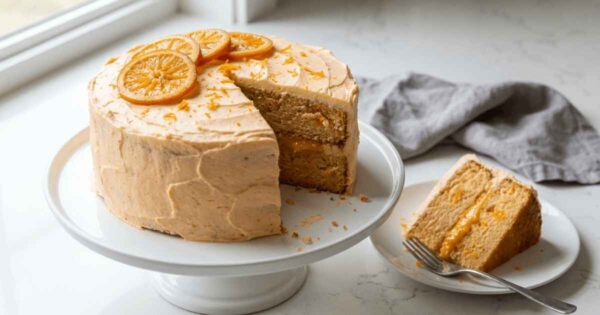
This orange creamsicle birthday layer cake trades the pan for a stand. Two tall rounds of orange-scented cake, a layer of orange curd running through the middle, and orange buttercream on the outside, finished with a few candied orange slices on top.
If you’ve made our orange creamsicle poke cake, this is a different project entirely. No gelatin, no holes to poke, no sheet pan. This one is built to stand tall and get sliced at a party, the way a birthday cake is supposed to look.
The part that trips people up isn’t the flavor. It’s the structure. A soft, moist crumb that’s also sturdy enough to hold two layers and a curd filling without slumping takes a bit of technique. That’s what most of this article is about.
Key Takeaways
- Bring eggs to room temperature before mixing or the batter can curdle and lose volume
- Make the orange curd first so it has time to cool and thicken before assembly
- A thin crumb coat, chilled for 20 minutes, makes the final frosting layer smooth
- This cake can be fully assembled a day ahead and stored in the fridge until serving
Table of Contents
What Makes This Orange Creamsicle Birthday Layer Cake Different?
Structure and presentation. A sheet cake bakes in one pan and gets served straight from it. This one bakes in two round pans, gets stacked with filling between the layers, and gets frosted on the outside so it stands as a centerpiece.
The orange flavor comes from two places working together: zest and juice mixed directly into the batter, and a layer of orange curd between the cake rounds. Curd is thicker and more concentrated than the batter itself, so it delivers a stronger citrus punch right in the center of every slice.
Why does the curd need to be made ahead? Curd thickens as it cools, and it needs to be fully cool and set before you spread it between warm cake layers. If it’s still warm and loose, it soaks into the crumb instead of staying as a distinct layer, and you lose the visual stripe of orange curd when you cut into the cake.
The buttercream matters too. A cream cheese buttercream flavored with orange zest and juice holds its shape at room temperature better than a plain whipped cream frosting would, which is part of why it works for a cake that needs to survive a party table for a few hours.
Why Room Temperature Ingredients Matter So Much Here
Cold eggs added to creamed butter and sugar can cause the mixture to seize, turning grainy and separated instead of smooth. This isn’t unique to this recipe, but it matters more in a layer cake than a sheet cake because a seized batter bakes unevenly, and uneven layers are hard to stack and frost cleanly. Warm eggs in a bowl of warm water for 10 minutes before you start mixing.
Ingredients
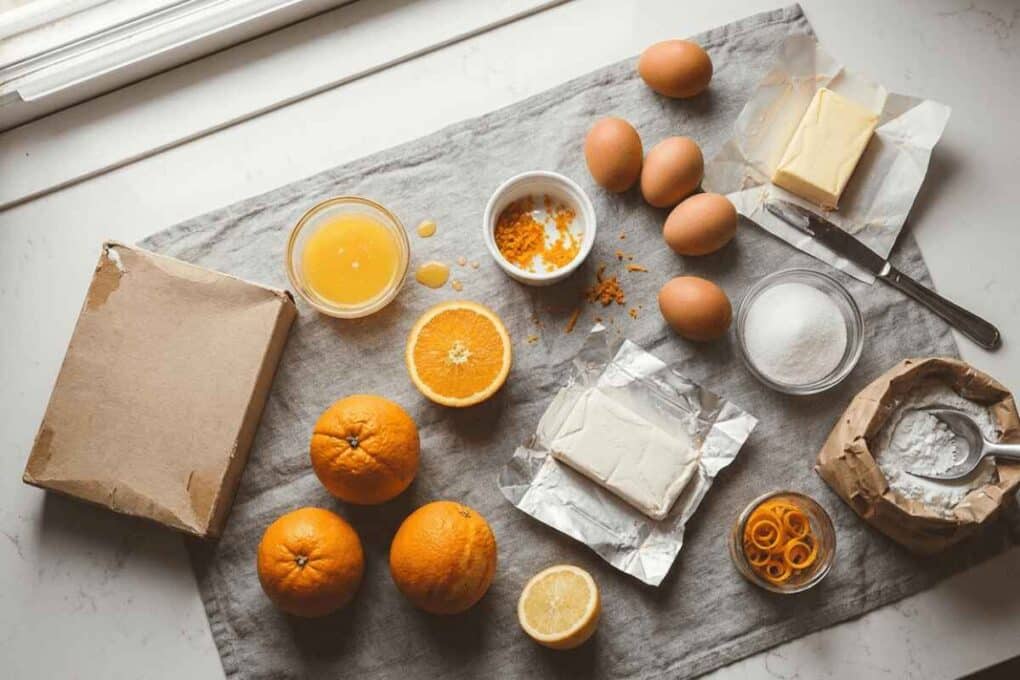
For the cake:
- 1 box white cake mix (15.25 oz)
- 3 large eggs, room temperature
- 1/3 cup vegetable oil
- 3/4 cup orange juice, room temperature
- 2 tablespoons fresh orange zest
For the orange curd filling:
- 3/4 cup fresh orange juice
- 2 tablespoons fresh lemon juice
- 1 cup granulated sugar
- 3 large eggs plus 2 egg yolks
- 6 tablespoons unsalted butter, cold, cut into pieces
- 1 tablespoon orange zest
For the orange cream cheese buttercream:
- 8 oz block cream cheese, softened
- 1 cup unsalted butter, softened
- 5 cups powdered sugar
- 3 tablespoons fresh orange juice
- 1 tablespoon orange zest
For garnish:
- Candied orange slices (see notes)
- Additional orange zest
A Note on Orange Zest and Pith
Only the colored outer layer of the peel goes into this cake. The white layer underneath, called the pith, carries most of the bitterness in citrus fruit and should be avoided entirely when zesting. A University of California food preservation guide explains that the flavorful oils sit in the outer colored layer, while the white pith beneath it is where the bitter compounds concentrate. A light hand with the zester keeps you in the flavorful zone.
Quick swap table:
| Original | Swap | Notes |
|---|---|---|
| Box white cake mix | From-scratch vanilla cake | More labor, deeper flavor control |
| Orange cream cheese buttercream | Orange Swiss meringue buttercream | Silkier texture, more technical to make |
| Fresh orange curd | Store-bought lemon curd, orange zest added | Faster, less bright orange flavor |
| Candied orange slices | Fresh orange segments | Less sweet, quicker garnish |
How to Make Orange Creamsicle Birthday Layer Cake, Step by Step
Three components come together here: curd, cake, and buttercream. Making the curd first gives it time to cool while the cake bakes.
Active time: About 1 hour Total time with cooling and assembly: 3 to 4 hours
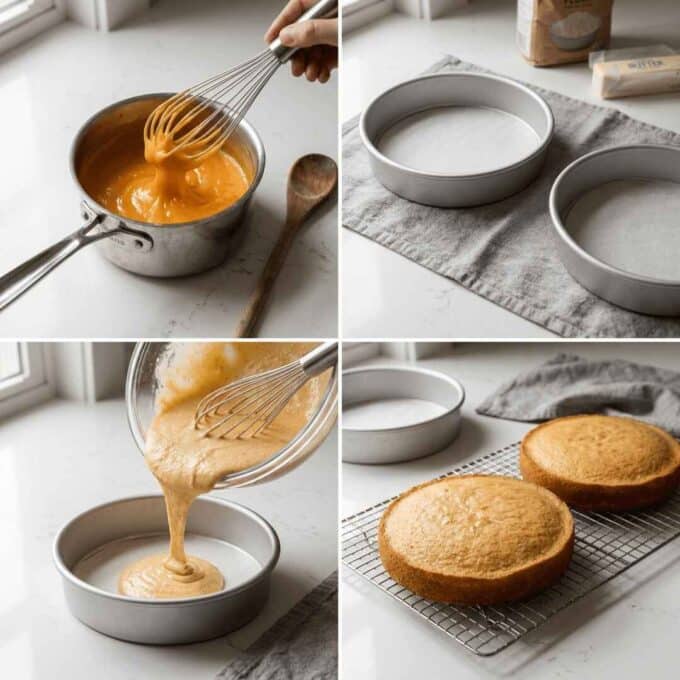
Step 1: Make the orange curd Whisk orange juice, lemon juice, sugar, whole eggs, and egg yolks together in a saucepan off the heat. Place over medium-low heat and cook, whisking constantly, until the mixture thickens enough to coat the back of a spoon, about 8 to 10 minutes. Remove from heat and whisk in cold butter, a piece at a time, until smooth. Stir in orange zest. Strain through a fine mesh sieve into a bowl, cover with plastic wrap pressed directly onto the surface, and refrigerate at least 2 hours.
Step 2: Prepare the pans Preheat oven to 350°F. Grease two 8-inch round cake pans and line the bottoms with parchment paper rounds.
Step 3: Mix the batter Whisk cake mix, room temperature eggs, oil, orange juice, and orange zest together until smooth, about 2 minutes. Divide evenly between the two prepared pans.
Step 4: Bake Bake 28 to 32 minutes, until a toothpick inserted in the center comes out clean. Cool in the pans for 10 minutes, then turn out onto a wire rack to cool completely, about 1 hour.
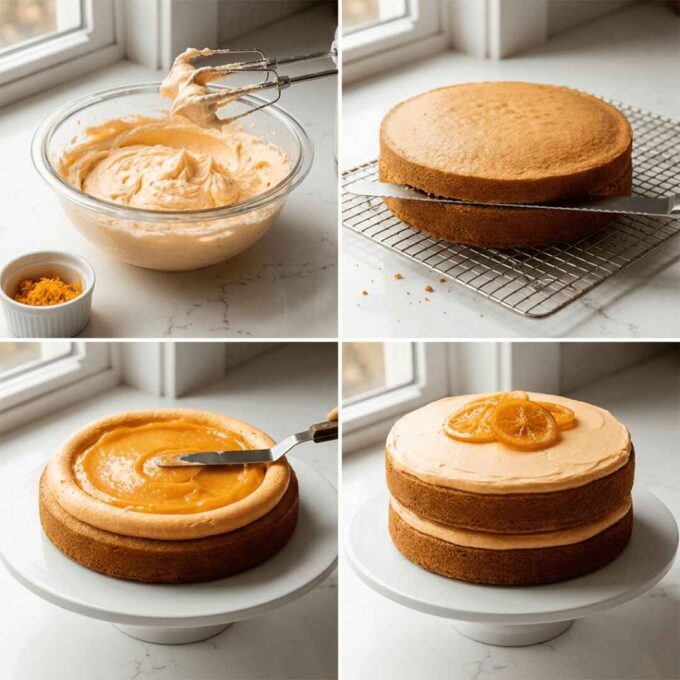
Step 5: Make the buttercream Beat softened cream cheese and butter together until smooth and fluffy, about 3 minutes. Gradually add powdered sugar, one cup at a time, beating well after each addition. Add orange juice and zest, then beat on high speed for 2 minutes until light and spreadable.
Step 6: Level the cake layers Once fully cooled, use a serrated knife to trim the domed top off each cake layer, creating a flat surface. This step matters more than it seems: domed layers create gaps and uneven stacking.
Step 7: Fill and stack Place the first cake layer on a cake board or serving plate. Pipe a ring of buttercream around the edge to act as a dam, then fill the center with the chilled orange curd, spreading it evenly up to the buttercream ring. Place the second cake layer on top, flat side up.
Step 8: Crumb coat Spread a thin layer of buttercream over the entire cake, thin enough that crumbs get sealed in rather than pulled loose. Refrigerate for 20 minutes to set.
Step 9: Final frost and decorate Apply the remaining buttercream in a smooth, even layer over the chilled crumb coat. Top with candied orange slices and a scatter of fresh zest just before serving.
Why the Buttercream Dam Matters
Piping a ring of stiff buttercream around the edge of the bottom layer before adding curd keeps the soft filling from squeezing out the sides when you add the second layer. Without the dam, curd pushes outward under the weight of the top layer and creates a mess along the seam.
5 Things That Go Wrong (And Why)
Mistake 1: Adding cold eggs to creamed butter Cold eggs can cause the butter mixture to seize and separate, which affects how evenly the cake bakes. Warm eggs in a bowl of warm water for 10 minutes before starting.
Mistake 2: Filling with warm curd Curd that hasn’t fully chilled is too loose to hold its shape between layers. It soaks into the cake instead of staying distinct. Give the curd the full 2 hours in the fridge before assembly.
Mistake 3: Skipping the crumb coat Frosting directly over an unsealed cake pulls crumbs into the final coat, leaving a speckled, uneven finish. The thin crumb coat step, even though it looks messy at first, is what makes the final layer clean.
Mistake 4: Not leveling the cake layers Domed layers rock instead of sitting flat when stacked, and the gap under the dome fills unevenly with filling or buttercream. A few minutes with a serrated knife fixes this before it becomes a problem.
Mistake 5: Overbeating the buttercream at the end Beating cream cheese buttercream too long after the sugar is incorporated can make it too soft to hold clean edges, especially in a warm kitchen. Beat just until light and spreadable, then stop.
Make-Ahead, Storage, and Freezing
This cake is well suited to making ahead, since each component can be prepared separately and combined closer to serving.
Curd: Can be made up to 1 week ahead, covered tightly in the refrigerator.
Cake layers: Can be baked up to 3 days ahead. Wrap cooled, unfrosted layers tightly in plastic wrap and store at room temperature or in the fridge.
Fully assembled cake: Once frosted, store covered in the refrigerator for up to 4 days. Bring to room temperature for about 30 minutes before serving for the best texture.
Freezer: Unfrosted cake layers freeze well for up to 3 months, wrapped tightly in plastic wrap. Thaw at room temperature before filling and frosting. The assembled, frosted cake does not freeze as well, since the curd filling can weep slightly after thawing.
For a completely different orange dessert, our no-bake orange creamsicle cheesecake skips the oven entirely and uses a springform pan instead of layer cake rounds.
Frequently Asked Questions
1. Can I use candied orange slices from a store instead of making my own?
Yes, if you can find them. Homemade candied slices are simmered in a sugar syrup until translucent, which takes about 15 minutes plus drying time, but the flavor and texture are noticeably better than most store options.
2. Why did my cake layers turn out dense instead of light?
Overmixing the batter after the flour or cake mix goes in develops too much structure, which weighs the crumb down. Mix just until the ingredients are combined and no streaks remain.
3. Can I make this cake with three layers instead of two?
Yes. Divide the batter among three pans instead of two, reducing bake time to about 20 to 24 minutes per layer. You’ll want to make 1.5 times the curd and buttercream recipe to fill and frost three layers properly.
4. Can I use a different citrus for the curd, like lemon or blood orange?
Yes. Blood orange curd has a deeper color and slightly more tart flavor, while lemon curd shifts the cake toward a lemon creamsicle profile. Keep the total citrus juice volume the same when swapping.
5. How far in advance can I decorate with candied orange slices?
Candied slices hold their shape for about 2 days if stored in an airtight container at room temperature. Add them to the finished cake as close to serving as possible, since moisture from the frosting can soften them over time.
An Honest Take
Layer cakes have a reputation for being harder than sheet cakes, and in one specific way, that’s true: stacking and frosting take more hand-eye coordination than pouring batter into a single pan. But the individual steps here, curd, buttercream, leveling, aren’t difficult on their own. It’s just more steps than a poke cake.
What you get for the extra effort is a cake that looks like a cake, the kind that gets photographed before anyone cuts into it. The orange curd stripe running through the center is the payoff, both visually and in flavor. It’s more concentrated than anything baked into the batter could be.
If you’re making this for a first birthday party or a milestone celebration, build in the extra day. Curd the day before, cake layers the day before, assemble the morning of. Nobody needs to know it took three sessions to get there.
More from the orange dessert collection: the orange creamsicle poke cake for a simpler sheet-pan version, or the orange creamsicle cake for the original 9×13 frosted classic.
Print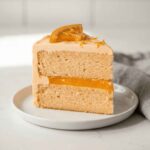
Orange Creamsicle Birthday Layer Cake,
- Total Time: 3 hours 30 minutes
- Yield: 12 servings
- Diet: Vegetarian
Description
This Orange Creamsicle Birthday Layer Cake features moist citrus cake layers filled with silky homemade orange curd and covered in a creamy orange cream cheese buttercream. It’s a bright, refreshing centerpiece that’s perfect for birthdays and special celebrations.
Ingredients
1 box (15.25 oz) white cake mix
3 large eggs, room temperature
1/3 cup vegetable oil
3/4 cup orange juice, room temperature
2 tablespoons fresh orange zest
3/4 cup orange juice
2 tablespoons lemon juice
1 cup granulated sugar
3 large eggs
2 egg yolks
6 tablespoons cold unsalted butter, cubed
1 tablespoon orange zest
8 ounces block cream cheese, softened
1 cup unsalted butter, softened
5 cups powdered sugar
3 tablespoons orange juice
1 tablespoon orange zest
Candied orange slices (optional)
Extra orange zest for garnish
Instructions
- Prepare the orange curd by whisking together the orange juice, lemon juice, sugar, whole eggs, and egg yolks in a saucepan. Cook over medium-low heat, whisking constantly, until thick enough to coat the whisk. Remove from the heat, stir in the butter and orange zest, strain if desired, and refrigerate until completely chilled.
- Preheat the oven to 350°F. Grease two 8-inch round cake pans and line the bottoms with parchment paper.
- Combine the cake mix, eggs, vegetable oil, orange juice, and orange zest until the batter is smooth. Divide evenly between the prepared pans.
- Bake for 28–32 minutes or until a toothpick inserted into the center comes out clean. Let the cakes cool in the pans for 10 minutes before transferring them to a wire rack to cool completely.
- Beat the softened cream cheese and butter until smooth. Gradually mix in the powdered sugar, then blend in the orange juice and orange zest until light and fluffy.
- Trim the tops of the cooled cake layers if needed. Pipe a ring of buttercream around the edge of the first layer, spoon the chilled orange curd into the center, then place the second cake layer on top.
- Spread on a thin crumb coat and chill for about 20 minutes. Finish frosting the cake with the remaining buttercream and decorate with candied orange slices and fresh orange zest before serving.
Notes
Using room-temperature eggs helps create a smooth, even cake batter.
Make sure the orange curd is completely chilled before assembling the cake.
A crumb coat helps lock in crumbs and creates a smooth professional-looking finish.
Store the finished cake covered in the refrigerator for up to 4 days, or freeze unfrosted cake layers for up to 3 months.
- Prep Time: 1 hour
- Cook Time: 30 minutes
- Category: Dessert
- Method: Baked
- Cuisine: American
Nutrition
- Serving Size: 1 slice
- Calories: 560
- Sugar: 55g
- Sodium: 330mg
- Fat: 28g
- Saturated Fat: 16g
- Unsaturated Fat: 11g
- Trans Fat: 0g
- Carbohydrates: 72g
- Fiber: 1g
- Protein: 6g
- Cholesterol: 125mg