

This orange creamsicle poke cake looks more impressive than it is. You see a photo of those orange ribbons running through every slice and assume there’s a technique you haven’t learned yet. There isn’t. You need a wooden spoon handle, a packet of orange gelatin mix, and the patience to wait 5 minutes before you poke.
That 5-minute window is the whole recipe, really. Get it wrong and you end up with a cake that’s either dry underneath, soggy on top, or missing the orange stripes entirely. Get it right and the whole thing tastes like a childhood creamsicle: cold, citrusy, with that hit of vanilla cream in every bite.
If you already love our orange creamsicle cake, the poke version takes that same flavor and pushes the moisture further than a standard recipe can.
Key Takeaways
- Wait exactly 5 minutes after baking before poking: the window that determines whether the gelatin soaks in or pools on top
- White cake mix (not yellow) makes the orange gelatin ribbons visible when you slice
- This cake tastes better on day two as the flavors settle overnight
- Four frosting options below with a quick comparison table
Table of Contents
What Actually Happens Inside a Poke Cake?
You bake a cake, poke holes across the top while it’s still warm, and pour a liquid filling into those holes. The cake absorbs the filling as it cools. That’s the whole method.
For this orange creamsicle poke cake, that filling is dissolved orange gelatin mix. The gelatin soaks into the cake, firms up in the fridge, and leaves bright orange ribbons through each slice. A vanilla cream topping goes over that, and together they hit the exact flavor of the classic creamsicle: bright citrus and sweet vanilla in the same bite.
Why does a warm cake absorb the gelatin better than a cold one? A freshly baked cake has a soft, open crumb structure. Warm liquid moves into those gaps easily. As everything cools together in the refrigerator, the gelatin sets and locks in that moisture permanently. A cake made this way stays soft for three or four days, sometimes getting better as the gelatin absorbs more deeply overnight.
Most failed poke cakes trace back to one of two timing errors: poking too soon (the holes collapse before the gelatin reaches them) or waiting too long (the crumb closes off). The 5-minute window sits between both mistakes. There’s no workaround for it.
What Does the Texture Feel Like Compared to Regular Cake?
A regular cake is at its best the day it’s baked. It dries out from there. This one does the opposite. By day two, the spots closest to the holes feel closer to a cold pudding than a dry crumb. The spots between holes stay more cake-like. You get both textures in the same pan, which is part of why it works so well served cold.
When you slice it right, you should see distinct orange ribbons running vertically through the white crumb. No stripes usually means one of two things: the cake base was yellow instead of white, or the timing was off.
Ingredients and Swaps Worth Knowing

The sizes here matter, especially for the gelatin and pudding mixes. These specific quantities keep the balance right, so don’t estimate.
For the cake:
- 1 box white cake mix (15.25 oz)
- 3 egg whites (per box directions)
- 1/3 cup vegetable oil
- 1 cup orange juice (used instead of water)
For the poke filling:
- 1 box orange gelatin dessert mix (3 oz)
- 1 cup boiling water
- 1/2 cup cold water
For the topping:
- 1 box instant vanilla pudding mix (3.4 oz)
- 1 cup cold whole milk
- 2 cups heavy whipping cream, whipped to soft peaks
Optional garnish:
- Fresh orange zest
- Mandarin orange segments, canned and well drained
Orange Juice or Orange Soda: Which One Works Better?
Both work. The difference is real but not dramatic.
Orange juice gives you a more natural citrus taste, slightly tart, closer to an actual orange. According to USDA FoodData Central, fresh-squeezed orange juice provides vitamin C, potassium, and folate, making it a more nutritious swap than plain water in your cake batter.
Quick swap table:
| Original | Swap | Notes |
|---|---|---|
| White cake mix | French vanilla cake mix | Richer flavor, but orange stripes are less visible |
| Whipped cream topping | Store-bought whipped topping | Use within 24 hours after opening |
| Orange gelatin mix | Homemade orange gelatin (see FAQ) | More natural flavor, less sweet |
| Orange juice in batter | Orange soda | Sweeter, slightly airier crumb |
| Whole milk in topping | 2% milk | Works fine, slightly less thick |
How to Make It, Step by Step
Making an orange creamsicle poke cake runs in four stages, each with a wait built in. Budget 4 to 5 hours if you’re making it same-day, or start the night before. The overnight version is noticeably better because the gelatin absorbs more deeply and the layers settle.
Active time: About 20 minutes total Total time with chilling: 4 to 5 hours minimum
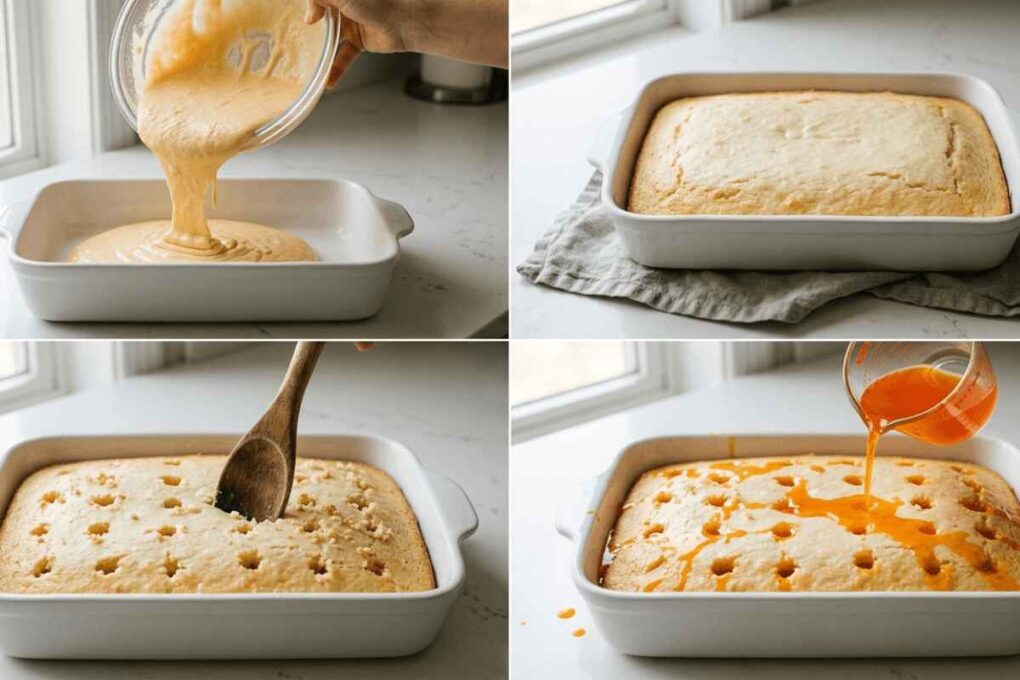
Step 1: Bake (25 to 30 minutes) Mix the batter per box directions, swapping orange juice for the water. Pour into a greased 9×13 pan and bake at 350°F until a toothpick in the center comes out clean, usually 25 to 30 minutes.
Step 2: Wait exactly 5 minutes Take the cake out and set a timer. Not three minutes. Not ten. Five. At this point the cake is still warm enough that the crumb is open and porous, but cool enough that the holes hold their shape when you poke. Too hot and the holes seal back up before the gelatin gets in. Fully cooled and the crumb has closed off, so the gelatin pools on the surface instead of soaking in.
Step 3: Poke the holes Use the handle end of a wooden spoon. Push holes about 1 inch apart across the whole surface, going all the way to the bottom of the pan. Don’t use a fork (too shallow) or a chopstick (too narrow to let the gelatin through).
Step 4: Mix and pour the gelatin Dissolve the 3 oz gelatin mix packet in 1 cup boiling water. Stir for 2 minutes until fully dissolved. Add 1/2 cup cold water and stir again. Pour the warm (not hot) mixture slowly and evenly over the cake. Let it find the holes on its own. Don’t spread it with a spatula or you’ll push it sideways across the surface instead of down into the cake.
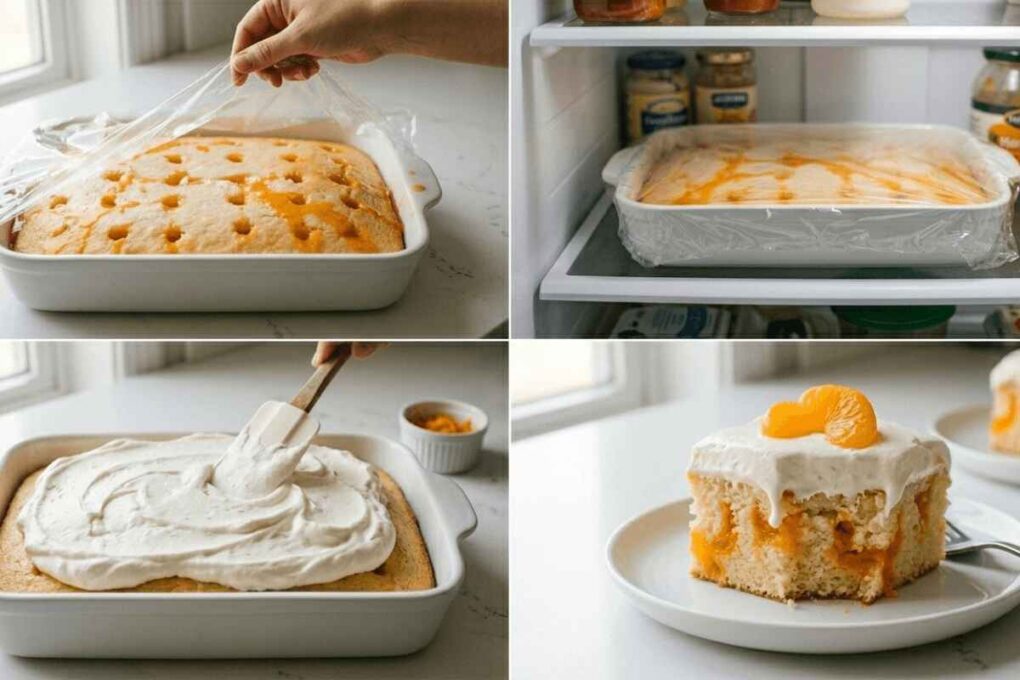
Step 5: Refrigerate 2 to 3 hours Cover loosely and refrigerate until the gelatin is fully set. Don’t add the topping yet. If you add it too early, the still-liquid gelatin mixes into the mousse and you lose the two distinct layers.
Step 6: Make the topping Whisk the instant vanilla pudding mix with 1 cup cold whole milk for 2 minutes until thick. Whip 2 cups of heavy cream to soft peaks in a separate bowl. Fold the whipped cream into the pudding gently until just combined. Over-mixing deflates it.
Step 7: Top and chill Spread the mousse evenly over the set gelatin layer. Back in the fridge for at least 30 more minutes.
Step 8: Garnish and cut Add orange zest or drained mandarin segments right before serving. Run a sharp knife under hot tap water and dry it completely before each cut. A warm dry blade goes through the gelatin ribbons cleanly without dragging them.
The Poke Technique in Detail
The holes have to reach the bottom of the pan. Poking only halfway means the bottom quarter of the cake stays dry. You’ll notice it when you serve: slices that are moist on top and noticeably drier underneath.
Spacing matters too. Holes every 2 inches or so gives you enough gelatin in every bite without compromising the structure of the cake. Go tighter than that and slices start falling apart when you try to lift them out.
How to Get the Orange Stripes
Three things determine whether the ribbons show up.
First, use white cake mix. Yellow cake has a golden tint that masks the orange gelatin entirely. You can still taste it, but you won’t see it, and the visual payoff is half of what makes this cake fun to serve.
Second, pour the gelatin slowly and let gravity do the work. Don’t spread.
Third, chill the full 2 to 3 hours. Partly-set gelatin bleeds into the crumb instead of holding its shape as a ribbon.
4 Frosting Options (With a Comparison Table)
Most recipes pick one topping and stop there. Here are four tested options so you can match the cake to the occasion and to what’s in your fridge.
Option 1: Whipped Cream and Vanilla Pudding Mousse (Classic) Whisk a 3.4 oz box of instant vanilla pudding with 1 cup cold whole milk for 2 minutes until thick. Fold in 2 cups of freshly whipped heavy cream. Light, airy, and cold. It lets the orange gelatin do the talking. Holds well in the fridge for up to 2 days.
Option 2: Orange Cream Cheese Frosting Beat 8 oz softened cream cheese with 1 cup powdered sugar, 2 tablespoons fresh orange juice, and 1 teaspoon orange zest. Fold in 1 cup whipped cream. Tangier and more structured than Option 1. It holds up better if the cake is sitting out at a gathering.
Option 3: Whipped Orange Cream Add 2 tablespoons of dry orange gelatin powder and 3 tablespoons powdered sugar to 2 cups cold heavy whipping cream. Whip to stiff peaks. The gelatin powder flavors and stabilizes the cream at the same time. More orange flavor in the topping, lighter than the cream cheese version.
Option 4: Condensed Milk Glaze Mix 1/2 cup sweetened condensed milk with 1/4 cup cream of coconut and pour the warm mixture over the poked cake at the same time as the gelatin filling. Let both soak in together, then top with plain whipped cream. Richer than the other three. Somewhere between a poke cake and a tres leches in texture.
| Frosting | Ease | Richness | Make-ahead | Room temp stability |
|---|---|---|---|---|
| Pudding mousse | Very easy | Light | Yes, up to 24 hrs | Keep cold |
| Cream cheese | Easy | Medium | Yes, up to 48 hrs | Medium |
| Whipped orange cream | Medium | Light | Yes, up to 24 hrs | Keep cold |
| Condensed milk glaze | Easy | Rich | Yes, overnight | Keep cold |
5 Things That Go Wrong (And Why)
Most poke cake problems are timing problems. Here’s what happens at each failure point.
Mistake 1: Poking right out of the oven. The holes collapse and seal before the gelatin reaches them. You end up with puddles on the surface and no stripes inside. The 5-minute wait is not optional.
Mistake 2: Waiting until the cake is fully cold. The crumb closes off. Gelatin sits on top like liquid on a plate and barely soaks in. If you forgot and the cake went fully cold, put it back in a 200°F oven for 5 minutes, then poke right away.
Mistake 3: Too many holes. More holes does not mean more moisture. It means a cake with no structure left to hold a slice together. Two inches apart, all the way to the bottom. That’s enough.
Mistake 4: Adding the topping before the gelatin sets. This is the most common mistake. The gelatin looks set on top but is still liquid underneath. You spread the mousse and it sinks through. Wait the full 2 to 3 hours. If you’re not sure, press the center gently with the back of a fork. It should feel firm all the way through.
Mistake 5: Pouring boiling-hot gelatin straight in. Dissolve the gelatin in boiling water, yes. But add the cold water before pouring and let the mixture cool for a minute. Boiling liquid straight into the holes over-saturates the crumb near the surface and makes those spots gummy instead of moist.
The warm knife trick makes a real difference at serving time. Run a sharp knife under hot tap water, dry it fully, and cut. Repeat before each slice. Cold or wet knives drag through the gelatin and smear the orange stripes you spent several hours waiting for.
Make-Ahead, Storage, and Freezing
This orange creamsicle poke cake genuinely tastes better the next day. The gelatin absorbs more deeply overnight and the layers settle into each other in a good way. If you have the choice, make it 24 hours before you plan to serve it.
Full make-ahead: Bake, add gelatin, spread the mousse topping, cover tightly, refrigerate up to 24 hours ahead.
Partial make-ahead: Bake and fill with gelatin the night before. Add the topping the morning you plan to serve.
Fridge storage: Covered, up to 3 to 4 days. By day 3 the topping may start to weep slightly but the cake is still good.
Freezer: Cut into individual slices first. Wrap each slice in cling film, place in a freezer bag. Up to 3 months. Thaw in the refrigerator for 2 hours before serving. Thawing on the counter makes the topping watery.
Serve cold, straight from the fridge. The gelatin ribbons are firmest when cold and the topping holds its shape best.
For a completely different direction in the same orange flavor family, our mandarin orange cake uses canned mandarins in the batter with a pineapple whipped topping. Same citrus world, different result.
Frequently Asked Questions
1. Does poke cake need to be refrigerated?
Yes. The gelatin filling and whipped cream topping both require refrigeration. Store covered in the fridge at all times and serve cold.
2. Can I freeze orange creamsicle poke cake?
Yes. Wrap individual slices tightly in cling film and freeze for up to 3 months. Thaw in the fridge for 2 hours before serving. Add the topping after thawing, not before freezing.
3. How many servings does a 9×13 poke cake make?
A standard 9×13 pan yields 12 to 15 servings, depending on slice size.
4. Can I use mandarin orange juice instead of cold water in the gelatin?
Yes. Replace the 1/2 cup cold water with mandarin orange juice for a more intense citrus flavor. Use juice from canned mandarins, well strained, not sweetened concentrate.
5. Can I make this gluten-free?
Yes. Use a gluten-free white cake mix in place of the regular one. All other ingredients in this recipe are naturally gluten-free. Check your gelatin and pudding mix labels to confirm.
6. Can I make it without packaged gelatin mix?
Yes. Combine 3/4 cup fresh orange juice, 2 tablespoons sugar, and 1 teaspoon unflavored bovine or agar-based gelatin powder. Heat briefly to dissolve, cool slightly, then use exactly like the packaged version.
7. Why did my poke cake turn out soggy?
The topping went on before the gelatin fully set. Always wait the full 2 to 3 hours and confirm the center feels firm before spreading the mousse.
An Honest Take
Poke cakes are honest food. This orange creamsicle poke cake uses box cake mix, packaged gelatin, and whipped cream. It’s not a project. You can make it on a weeknight without special equipment.
But the result is genuinely good in a way that fancier orange cakes rarely manage. The gelatin keeps the crumb moist in a way that oil and buttermilk alone can’t replicate. The pudding mousse is lighter than buttercream and doesn’t compete with the orange underneath. And the stripes, when you get the timing right, are satisfying in a way that’s hard to explain until you’ve sliced into one.
The cream cheese option (Option 2) is underrated if you haven’t tried it yet. It brings a little tang that plays well against the sweet orange gelatin. Drop a comment and tell me which frosting you went with.
More from the orange cake collection: the orange creamsicle cake that started this cluster, or the mandarin orange cake for something completely different.
Print
Orange Creamsicle Poke Cake
- Total Time: 4 hours 45 minutes
- Yield: 15 servings
- Diet: Vegetarian
Description
This Orange Creamsicle Poke Cake is light, moist, and bursting with bright citrus flavor. Orange gelatin soaks into a fluffy white cake before it’s topped with a silky vanilla mousse, creating a refreshing dessert that’s perfect for parties, holidays, or summer gatherings.
Ingredients
1 box (15.25 oz) white cake mix
3 egg whites
1/3 cup vegetable oil
1 cup orange juice or orange soda
1 box (3 oz) orange gelatin dessert mix
1 cup boiling water
1/2 cup cold water
1 box (3.4 oz) instant vanilla pudding mix
1 cup cold whole milk
2 cups heavy whipping cream, whipped to soft peaks
Fresh orange zest (optional)
Mandarin orange segments, drained (optional)
Instructions
- Preheat the oven to 350°F and lightly grease a 9×13-inch baking dish. Prepare the cake batter using orange juice or orange soda instead of water, then bake for 25–30 minutes until a toothpick inserted in the center comes out clean.
- Allow the cake to cool for 5 minutes, then use the handle of a wooden spoon to poke holes about 1 inch apart across the entire surface, reaching almost to the bottom.
- Whisk the orange gelatin into the boiling water until completely dissolved, then stir in the cold water. Slowly pour the mixture evenly over the cake so it fills the holes.
- Cover the cake and refrigerate for 2–3 hours, allowing the gelatin to fully set inside the cake.
- Whisk the vanilla pudding mix with the cold milk for about 2 minutes until slightly thickened. Gently fold in the whipped cream to create a light vanilla mousse.
- Spread the mousse evenly over the chilled cake and refrigerate for another 30 minutes before serving.
- Decorate with fresh orange zest or mandarin orange segments if desired. For neat slices, dip your knife in hot water and wipe it dry before each cut.
Notes
A white cake mix creates the best contrast for the orange gelatin ribbons.
Orange soda produces a sweeter, lighter cake, while orange juice adds a brighter citrus flavor.
Preparing the cake a day ahead gives the gelatin more time to soak into the crumb.
Store covered in the refrigerator for up to 4 days or freeze individual slices for up to 3 months.
- Prep Time: 15 minutes
- Cook Time: 28 minutes
- Category: Dessert
- Method: Baked
- Cuisine: American
Nutrition
- Serving Size: 1 slice
- Calories: 285
- Sugar: 27g
- Sodium: 290mg
- Fat: 13g
- Saturated Fat: 7g
- Unsaturated Fat: 6g
- Trans Fat: 0g
- Carbohydrates: 39g
- Fiber: 0g
- Protein: 3g
- Cholesterol: 45mg