
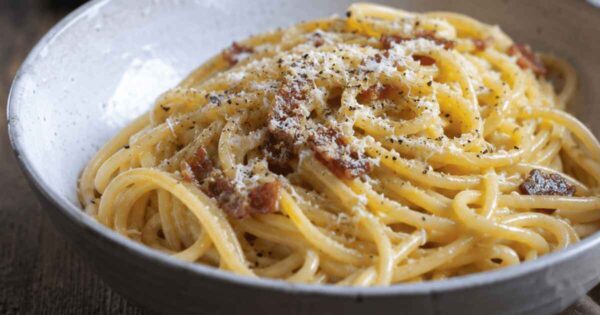
I tipped the eggs straight into a pan that was still on the burner. Scrambled in about ten seconds. After burning about four batches I figured out that pan temperature is the only thing that actually matters.
Four ingredients, 30 minutes, one rule.
⏱ Prep: 10 min | 🔥 Cook: 20 min | 🍽 Serves: 4 | Difficulty: Beginner
Key Takeaways
- Authentic carbonara relies on eggs, cheese, and pasta water for its sauce, not cream — the pan must be off the heat before the eggs go in, or they scramble instead of forming a silky sauce
- Extra egg yolks are added alongside whole eggs because their lecithin acts as a natural emulsifier, giving the sauce a smoother, richer texture
- Pecorino Romano is the traditional cheese, valued for being sharper and saltier than Parmesan, which lets it stand up to the richness of the egg yolks
- Starting the bacon in a cold pan renders the fat gradually, producing evenly crispy pieces instead of pieces that are crisp outside but greasy and chewy inside
Table of Contents
The one rule
The pan goes off the heat before the eggs go in. The residual warmth from the pasta cooks the egg sauce perfectly. A live burner cooks it in seconds.
Why Spaghetti Carbonara Recipe works
Extra egg yolks go in alongside the whole eggs because yolks contain lecithin, a natural emulsifier that binds fat and water into a stable sauce. Whole eggs alone give you something thinner.
Pecorino Romano is the main cheese because it is sharper and saltier than Parmesan and holds its own against the richness of the yolks. A small amount of Parmigiano rounds it off.
The beef bacon starts in a cold pan so the fat renders gradually. A hot pan crisps the surface before the interior fat melts, leaving chewy, greasy pieces instead of properly crispy ones.
Ingredients
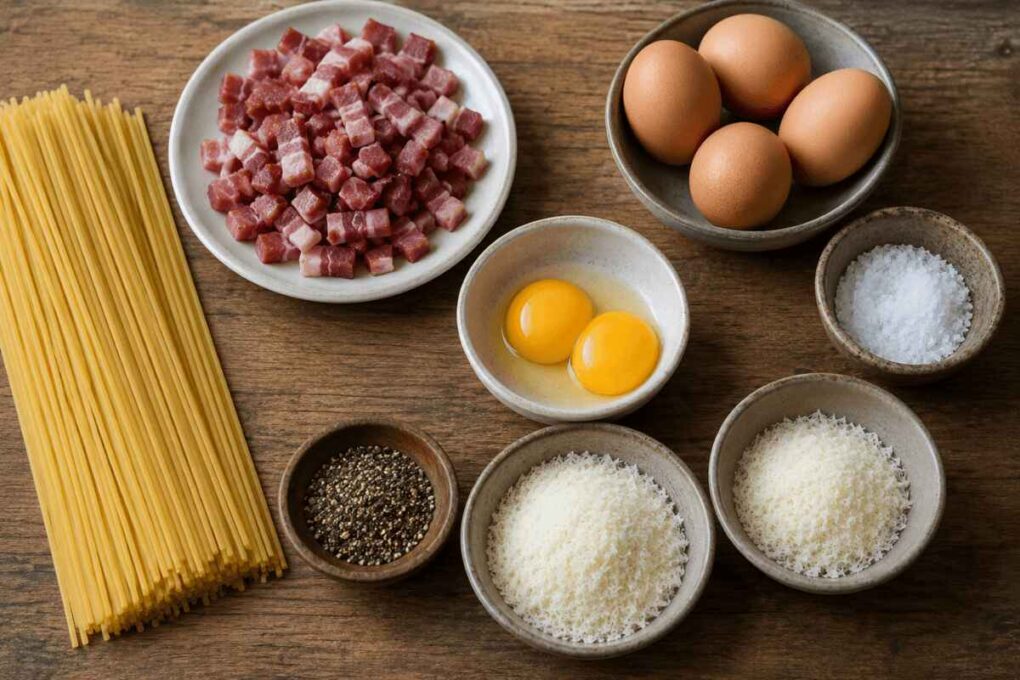
- 14 oz (400g) spaghetti, or rigatoni
- 7 oz (200g) cured beef bacon, cut into small cubes or short strips
- 4 large whole eggs, room temperature
- 2 extra large egg yolks, room temperature
- 3½ oz (100g) Pecorino Romano, finely grated
- 1 oz (30g) Parmigiano-Reggiano, finely grated
- 1 tsp freshly cracked black pepper, heaped, plus more to finish
- Kosher salt for the pasta water only
Ingredient notes: Buy Pecorino Romano as a block, not pre-grated; grate it on the finest side of a box grater. For the beef bacon, look for a well-marbled cured cut at a specialty butcher. The rendered fat is the foundation of the sauce. Take the eggs out of the fridge 30 minutes before you start. Use black pepper from a mill, cracked fresh.
Instructions
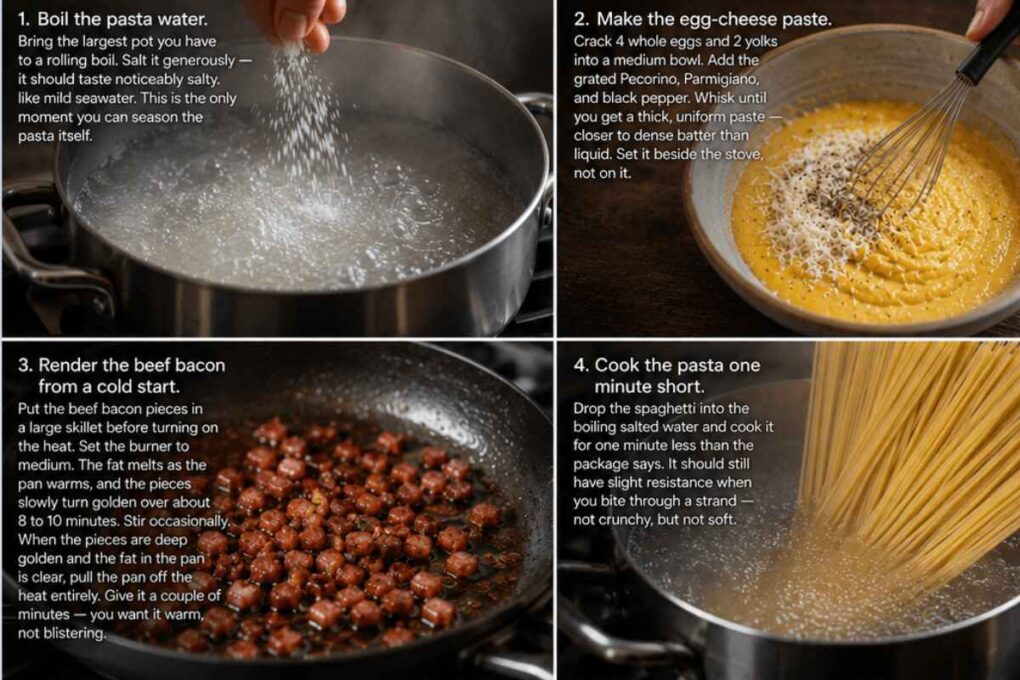
1. Boil the pasta water. Bring a large pot to a rolling boil. Salt it generously until it tastes like mild seawater.
2. Make the egg-cheese paste. Crack 4 whole eggs and 2 yolks into a bowl. Add the grated Pecorino, Parmigiano, and black pepper. Whisk into a thick, uniform paste. Set it beside the stove, not on it.
3. Render the beef bacon from a cold start. Put the beef bacon in a large skillet before turning on the heat. Set the burner to medium. The fat melts as the pan warms and the pieces turn golden over 8 to 10 minutes. When they are deep golden and the fat is clear, pull the pan off the heat and give it two minutes.
4. Cook the pasta one minute short. Drop the spaghetti into the boiling salted water and cook it one minute less than the package says. It should still push back slightly when you bite through a strand.
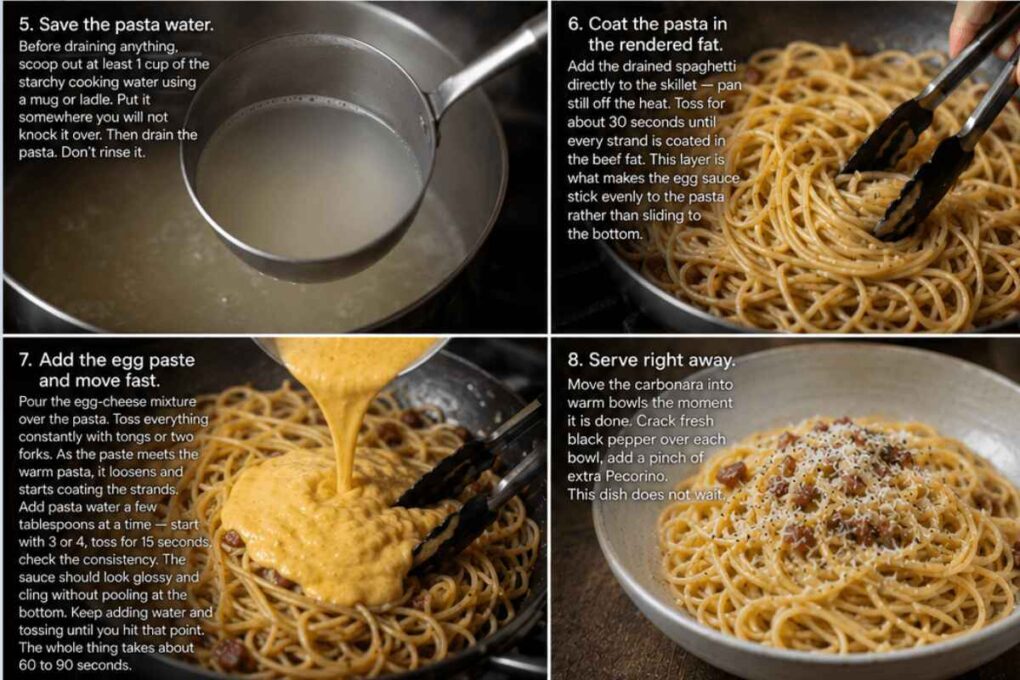
5. Save the pasta water. Before draining, scoop out at least 1 cup of the starchy cooking water using a mug. Set it aside. Then drain the pasta without rinsing it.
6. Coat the pasta in the rendered fat. Add the drained spaghetti directly to the skillet, pan still off the heat. Toss for 30 seconds until every strand is coated.
7. Add the egg paste and move fast. Pour the egg-cheese mixture over the pasta. Toss constantly with tongs or two forks. Add pasta water a few tablespoons at a time, toss for 15 seconds between each addition, and check the consistency. The sauce should look glossy and cling without pooling at the bottom. The whole thing takes about 90 seconds.
8. Serve right away. Move the carbonara into warm bowls immediately. Crack fresh black pepper over each bowl and add a pinch of extra Pecorino.
Tips that make a real difference
Warm the serving bowls by filling them with hot tap water while you cook, then emptying them just before plating. Carbonara tightens quickly as it cools.
Use more pasta water than feels right. The sauce should look slightly looser in the pan than you want it, because it thickens in the bowl.
Taste before adding salt. The Pecorino, beef bacon, and salted pasta water together usually cover it.
What will ruin it
Adding the eggs while the pan is still hot. This is the one rule broken. Pull the pan off, wait 90 seconds, then add the egg mixture while tossing constantly.
Draining the pasta without saving any water. Put a mug in the colander before you start so you cannot forget.
Using bagged pre-grated cheese. Anti-caking agents stop it from melting cleanly and the sauce comes out grainy. Two extra minutes of grating from a block fixes this.
Adding cream. It dilutes the egg proteins that hold the emulsion together and makes the sauce heavier without improving the texture.
For people managing blood sugar
A full serving has around 60g of carbs, all from the pasta. The sauce itself has almost none. Use 2.5 oz / 70g dry pasta per serving, swap to whole-wheat or chickpea spaghetti for more fiber, and pair with a large salad. Talk to your doctor for personalized guidance.
Substitutions
| Ingredient | Alternative | Notes |
|---|---|---|
| Cured beef bacon | Smoked turkey strips | Add 1 tbsp olive oil; turkey renders very little fat (other ways to add protein to pasta) |
| Spaghetti | Rigatoni | Tube shape traps sauce inside |
| Spaghetti | Whole-wheat spaghetti | More fiber, lower glycemic index |
| Pecorino Romano | Aged Parmesan, same amount | Milder, nuttier, easier to find |
Storage
Leftovers keep for 2 days in the fridge. Reheat on the stovetop over low heat with a splash of water, tossing until the sauce loosens. Do not freeze; the egg-based emulsion separates when thawed. The egg-cheese paste can be made 24 hours ahead; refrigerate it and bring it to room temperature before using.
Nutrition (estimated, per serving)
| Nutrient | Per serving |
|---|
| Nutrient | Per serving |
|---|---|
| Calories | 620 kcal |
| Total fat | 28g |
| Saturated fat | 11g |
| Sodium | 820mg |
| Total carbohydrates | 62g |
| Dietary fiber | 3g |
| Protein | 28g |
Estimates based on an online food database. Actual values vary depending on specific ingredients used.
More Roman pasta recipes:
classic Italian pastina soup
Thirty minutes. If it works, leave a comment. If it doesn’t, tell me what happened.
FAQ:
1. Are the eggs in carbonara safe to eat?
Yes. The heat from the pasta reaches around 86°C, which is enough to eliminate Salmonella at normal contamination levels. If you are immunocompromised or cooking for young children, use pasteurized eggs as a precaution.
2. Can you eat carbonara when pregnant?
Yes, if you use pasteurized eggs. Regular eggs are not fully cooked in this dish. Pasteurized shell eggs are available in most supermarkets and remove the risk entirely. The beef bacon is safe, it is fully cooked during the rendering step. official guidance on eggs during pregnancy
3. Where does carbonara come from?
The origin is disputed. One theory links it to Italian charcoal workers in the Apennine mountains who needed shelf-stable, portable food. A second, better-documented theory places it in Rome around 1944, when American soldiers supplied bacon and eggs to local cooks. Either way, it is a 20th-century dish, not an ancient one. Italian pasta varieties and their differences
4. Why did my sauce turn greasy instead of creamy?
The pan was too hot when the eggs went in, or you did not toss vigorously enough during the first 90 seconds. A greasy sauce means the fat separated before it could emulsify. Add a splash of pasta water and toss constantly over very low heat, it usually comes back together within 30 seconds.
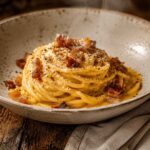
Authentic Spaghetti Carbonara Recipe
- Total Time: 30 minutes
- Yield: 4 servings
Description
This Spaghetti Carbonara delivers silky, creamy pasta without any cream. Crispy cured beef bacon, freshly grated Pecorino Romano, Parmigiano-Reggiano, and eggs create a rich, authentic-style sauce that’s ready in just 30 minutes.
Ingredients
14 ounces (400g) spaghetti or rigatoni
7 ounces (200g) cured beef bacon, diced
4 large eggs, room temperature
2 large egg yolks, room temperature
3½ ounces (100g) Pecorino Romano, finely grated
1 ounce (30g) Parmigiano-Reggiano, finely grated
1 heaped teaspoon freshly cracked black pepper, plus extra for serving
Kosher salt, for the pasta water only
Instructions
- Bring a large pot of water to a rolling boil and season generously with kosher salt until it tastes lightly salty.
- Whisk together the whole eggs, egg yolks, grated Pecorino Romano, Parmigiano-Reggiano, and black pepper until a thick, smooth mixture forms. Set aside.
- Place the diced beef bacon into a cold skillet, then cook over medium heat for 8–10 minutes until the fat renders and the pieces become crisp and golden. Remove the pan from the heat and let it cool for about 2 minutes.
- Cook the spaghetti one minute less than the package directions for an al dente texture. Before draining, reserve at least 1 cup of the starchy pasta water.
- Transfer the hot pasta directly to the skillet and toss until every strand is coated with the rendered beef bacon fat.
- Pour the egg and cheese mixture over the pasta, tossing continuously. Add the reserved pasta water a few tablespoons at a time until the sauce becomes silky, creamy, and evenly coats the pasta.
- Serve immediately in warm bowls with extra freshly cracked black pepper and an additional sprinkle of Pecorino Romano.
Notes
Use freshly grated cheese for the smoothest, creamiest sauce.
Room-temperature eggs help prevent the sauce from becoming grainy.
Always remove the skillet from direct heat before adding the egg mixture to avoid scrambling the eggs.
Reserve plenty of pasta water—it is the key to achieving a glossy carbonara sauce.
- Prep Time: 10 minutes
- Cook Time: 20 minutes
- Category: Main Course
- Method: Stovetop
- Cuisine: Italian
Nutrition
- Serving Size: 1 bowl
- Calories: 685
- Sugar: 2g
- Sodium: 890mg
- Fat: 30g
- Saturated Fat: 12g
- Unsaturated Fat: 16g
- Trans Fat: 0g
- Carbohydrates: 64g
- Fiber: 3g
- Protein: 37g
- Cholesterol: 295mg